Best Private AI Assistants: How to Use AI Without Giving Away Your Data

Most of us use artificial intelligence every day, whether we’re summarizing lengthy documents, drafting emails, troubleshooting code, or brainstorming ideas. But using mainstream tools often comes with an underlying risk: your questions, files, and conversational habits are frequently logged, tied to your digital identity, and used to train future models.
If you want the power of modern AI without surrendering your personal data, several privacy focused alternatives offer a different approach to how your information is handled.
This guide explores how these tools work, what privacy protections they offer, where their limitations lie, and how to choose one that best fits your workflow.
1. Proton Lumo: Encrypted Workspaces & Legal Sovereignty
Best for: Secure project organization, long-term memory, and maximum legal protection.
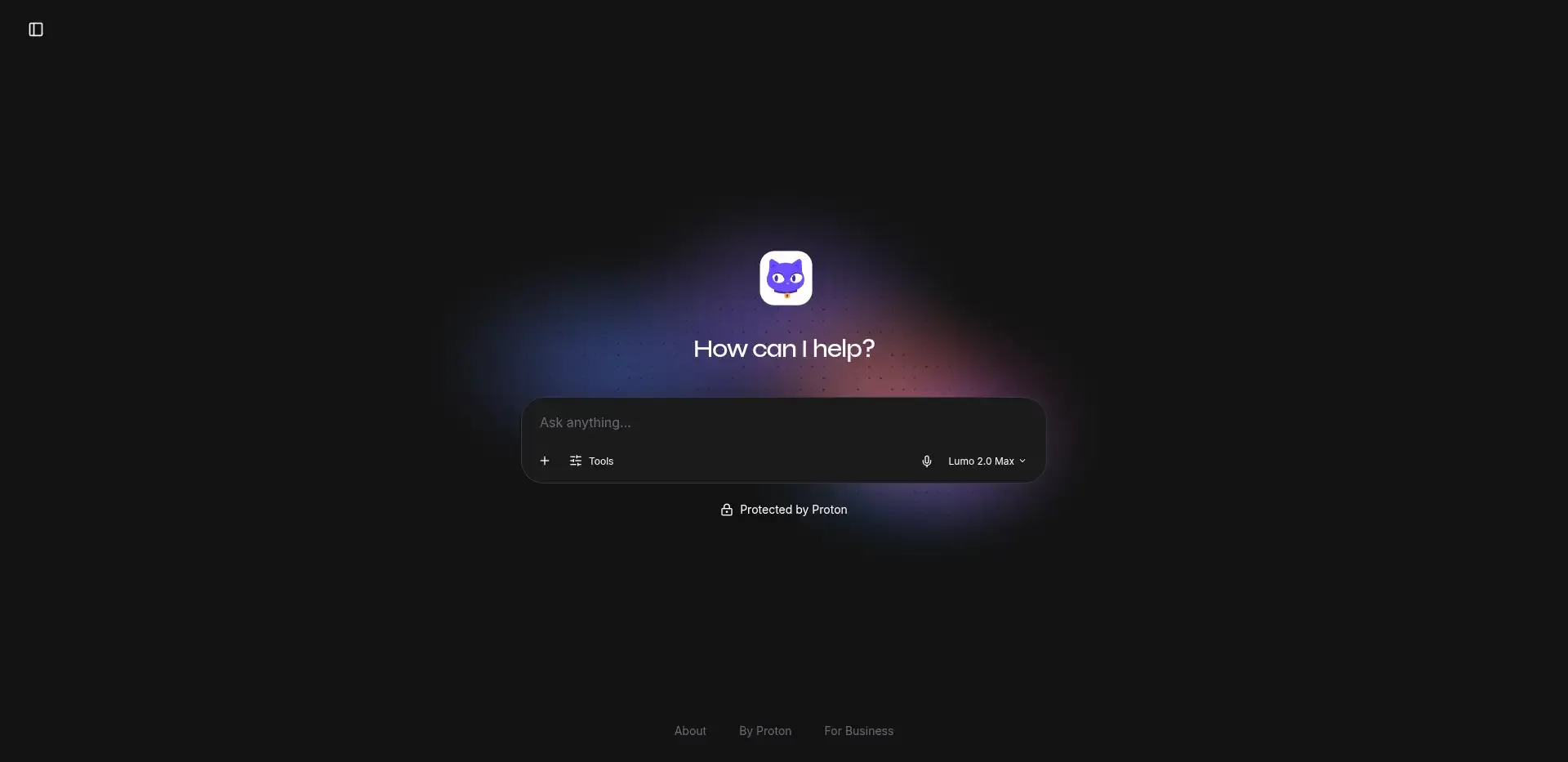
Built by Proton AG, the Swiss team behind Proton Mail and Proton VPN. Lumo takes a cryptographic approach to personal AI. It is designed for people who want continuous memory, custom system prompts, and organized workspaces without exposing their data to third-party providers.
- Zero-Access Encryption: When you save chats, documents, or custom instructions, they are encrypted directly on your device using keys tied to your credentials before syncing to Proton’s cloud. If Proton’s servers were ever breached, they could only hand over unreadable ciphertext.
- No-Log Inference: While the AI model must temporarily decrypt your prompt in volatile GPU RAM to generate an answer, Proton enforces an architecturally verified no-logs policy that immediately wipes the memory once your response is returned.
- Self-Hosted Open Weights: Unlike platforms that pass your prompts to outside APIs, Proton hosts models like Qwen 3.5 and GLM 5.3 entirely on its own infrastructure.
- The Swiss Legal Shield: Because Proton operates strictly out of Switzerland and Germany, it is shielded from the US CLOUD Act. Law enforcement cannot force Proton to hand over data without surviving strict Swiss judicial review.
- Pricing: Lumo provides a free tier, alongside Lumo Plus ($12.99/month) for advanced workspaces and image tools, and Lumo Professional ($14.99/user/month) for teams.
2. Duck.ai by DuckDuckGo: Anonymous Access to Frontier Models
Best for: Zero-setup and accessing top models without an account.
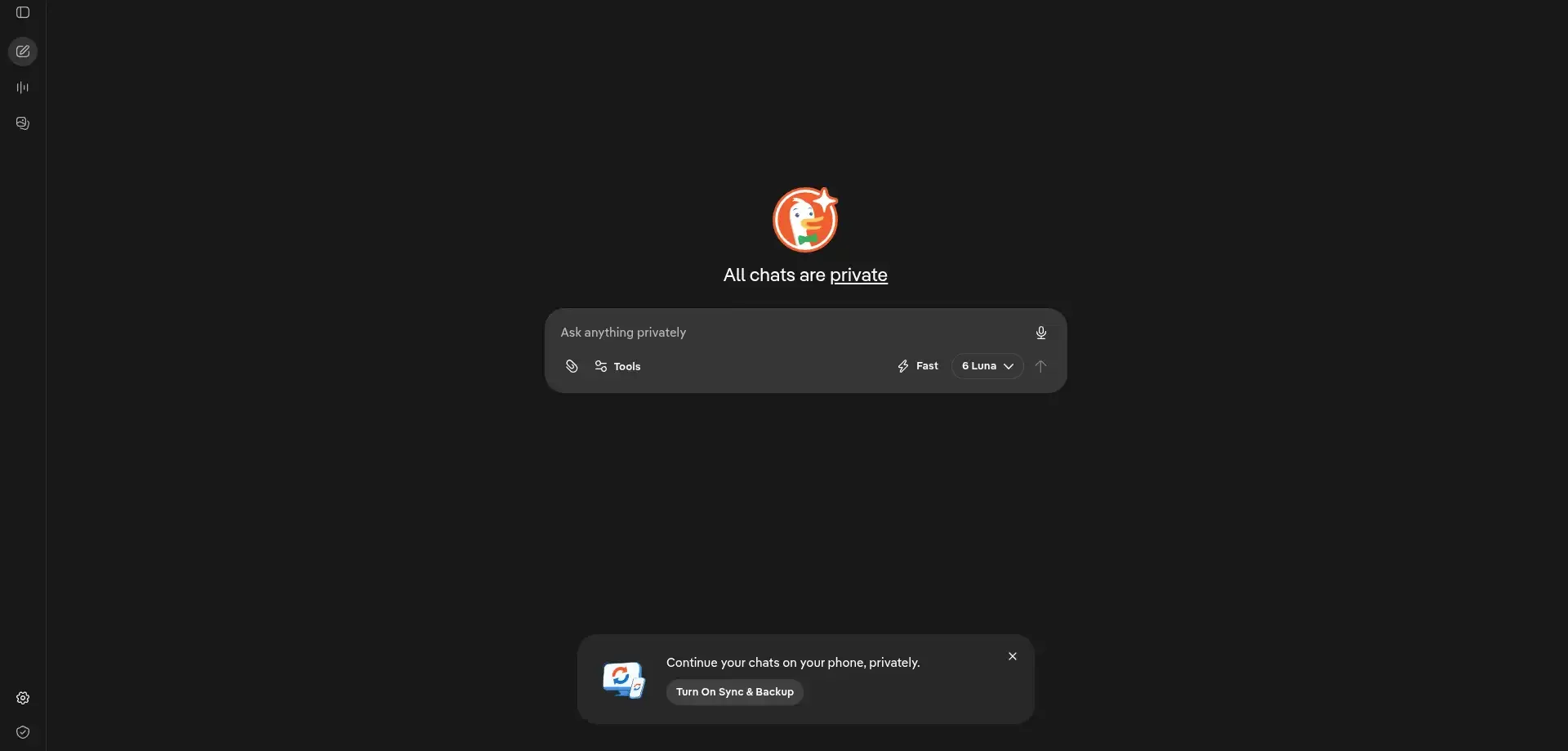
If you want access to cutting-edge models like OpenAI’s GPT or Anthropic’s Claude but refuse to build an account profile with Big Tech, DuckDuckGo’s Duck.ai acts as an anonymizing shield.
- Identity-Stripping Proxy: When you enter a prompt, Duck.ai strips out your IP address, device fingerprint, and personal identifiers. To the model provider, every incoming request looks identical and originates purely from DuckDuckGo.
- Strict Anti-Training Agreements: DuckDuckGo enforces contractual agreements barring model hosts from retaining your inputs long-term or using your conversations to train their algorithms.
- Hardware Enclaves (TEEs): For hosted open-source models, Duck.ai partners with Tinfoil to run inference inside Trusted Execution Environments. These hardware enclaves ensure that even the server host is mathematically blocked from viewing your prompts or results.
- Local Ephemerality: Duck.ai saves your chat history exclusively within your local browser storage by default, keeping zero persistent conversational memory on remote servers.
- Pricing: Completely free to use with models like Claude Haiku 4.5 , GPT-6 Luna and GPT-5.4 mini, with expanded model tiers available (limited to some countires) under DuckDuckGo subscription plan ($9.99/month), which is currently available only in select countries.
3. Brave Leo: Frictionless In-Browser Intelligence
Best for: Summarizing live web pages, analyzing PDFs, and workflow speed.
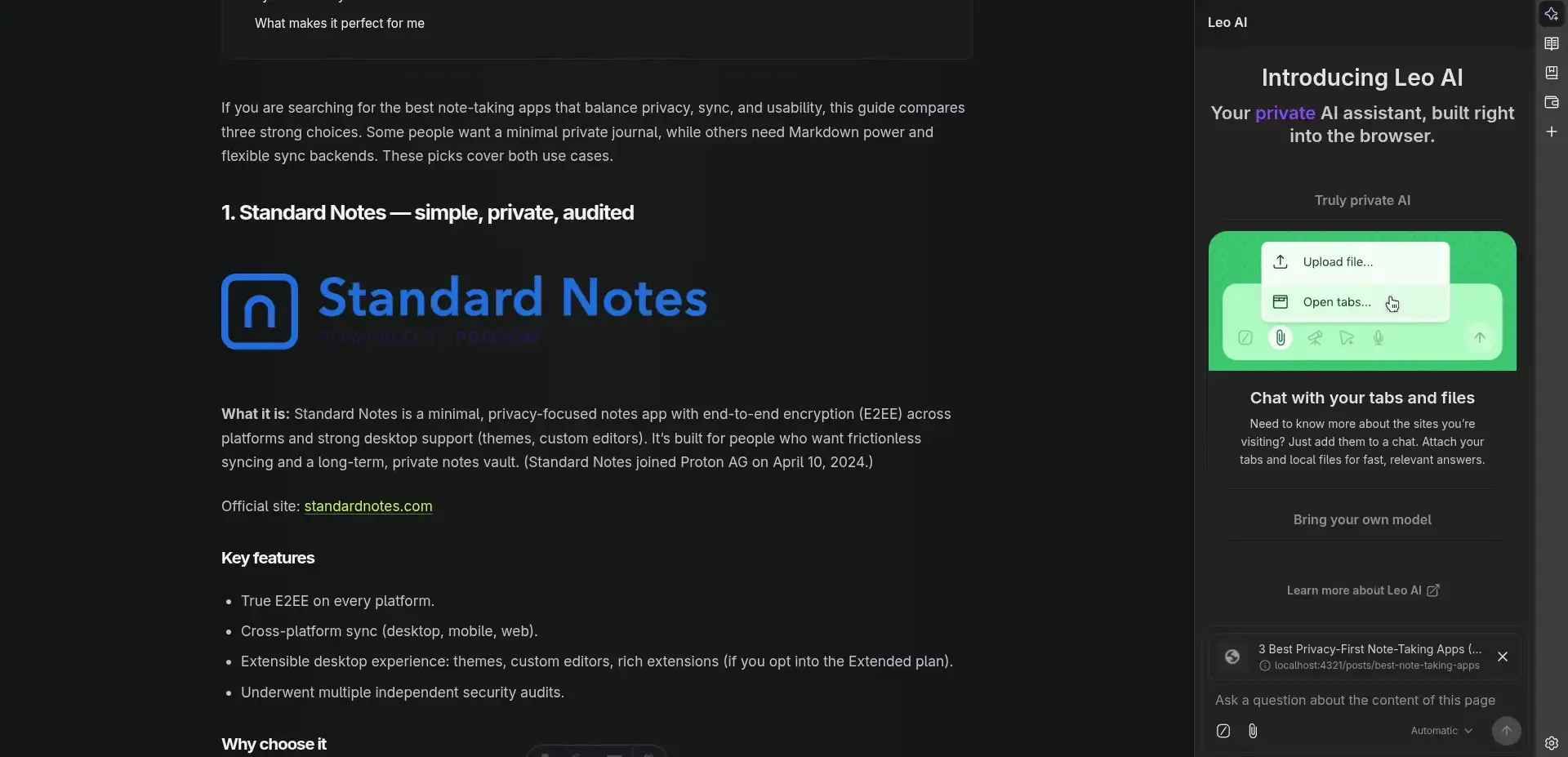
Rather than functioning as a standalone destination site, Leo lives right in the sidebar of the Brave browser across desktop and mobile. It focuses on contextual web intelligence: summerizing articles, extracting data, and working with documents in your active tab.
- Ephemeral Reverse Proxy: Leo anonymizes network requests and drops all conversation data immediately after a session ends, ensuring zero persistent server-side retention.
- Sandboxed Security Against Web Attacks: Because Leo reads website code directly, it is naturally exposed to Indirect Prompt Injections (where malicious sites hide invisible text commands to hijack an AI). Brave counters this by running Leo inside an isolated browser sandbox and using a secondary “alignment checker” model that evaluates actions before running them.
- Pricing: Advanced AI models and higher usage limits locked behind a paid Leo Premium subscription.
Comparison: Which Tool Is Right for You?
| Feature | Proton Lumo | Duck.ai | Brave Leo |
|---|---|---|---|
| History Retention | Encrypted cloud sync | Local browser storage only | Discarded after session |
| Model Selection | Self-hosted open weights | Anthropic, OpenAI, Meta, Mistral | Mixtral, Llama, Claude |
| Account Required? | Optional for basic; required for history sync | No | No |
| Jurisdiction | Switzerland / EU | United States | United States |
If your priority is a secure, persistent workspace for personal notes and research, Proton Lumo provides the strongest end-to-end cryptographic and legal boundary. If you want quick, throwaway chats with the industry’s most powerful frontier models without an account, Duck.ai delivers the best anonymity. And if you want an assistant that lives right in your browser to break down pages and documents, Brave Leo offers the smoothest daily experience.